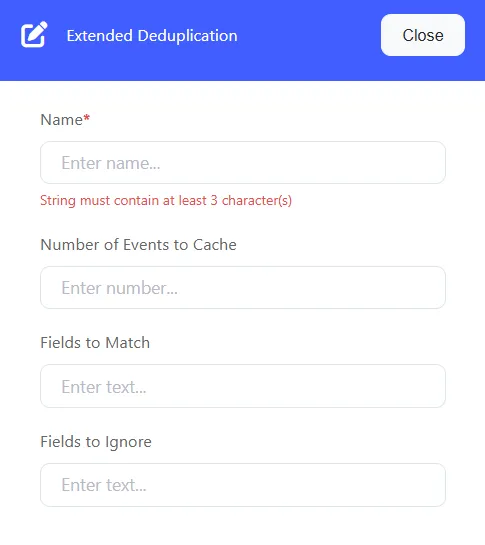
Deduplication
In Kron TP, deduplication refers to the process of identifying and removing duplicate or redundant data points within a dataset. The primary goal of deduplication is to ensure that only unique and distinct data is processed or stored, thereby improving the efficiency of the pipeline and reducing unnecessary computational and storage overhead. Additionally, by defining conditions using the "ignore" and "match" parameters, deduplication can be customized to include or exclude specific scenarios, allowing for the attainment of desired outcomes based on defined conditions. Here are some key aspects and benefits of deduplication in a telemetry pipeline:
Conserving Resources:
By discarding duplicate data, deduplication conserves valuable resources such as storage space and network bandwidth. This is crucial for optimizing the performance of telemetry pipelines, especially in scenarios with high data throughput.
Reducing Computational Load:
Processing duplicate data points incurs unnecessary computational load. Deduplication ensures that only unique data is processed, reducing the computational burden on the telemetry pipeline and associated systems.
Improving Query Performance:
Deduplication enhances the performance of data queries and analytics by reducing the dataset's size. Smaller datasets result in faster query response times and more efficient analysis, especially when dealing with historical telemetry data.
Basic Deduplication vs. Advanced Deduplication
Basic Deduplication is a simpler form of deduplication that focuses on eliminating duplicate events based on simple, predefined criteria. It operates on raw event data without the need for complex processing or a structured data format. In this form, deduplication can be achieved by checking specific fields, like timestamps or event IDs, using basic matching criteria such as string comparison or regular expressions.
Advanced Deduplication, on the other hand, provides a more structured approach to handling duplicates. It operates on parsed data and uses a more sophisticated language (e.g., VRL - Vector Remap Language). This allows for more complex conditions and operations, such as checking multiple attributes or performing conditional logic, making it ideal for situations where data is already parsed and follows a specific structure. Advanced deduplication allows for greater flexibility and precision in defining what constitutes a duplicate and how to handle it.