AAPM Agent Installation in Windows Environments
The agent files found in the Kron Repository are uploaded to the Windows environment where the agent will run, and the kron-aapm-agent.exe is executed to perform the agent installation. Additionally, SDK files are included in the repository. These SDK files do not need to run in the same environment as the agent. Further details will be provided under the section Using AAPM Agent SDKsUsing AAPM Agent SDKs.
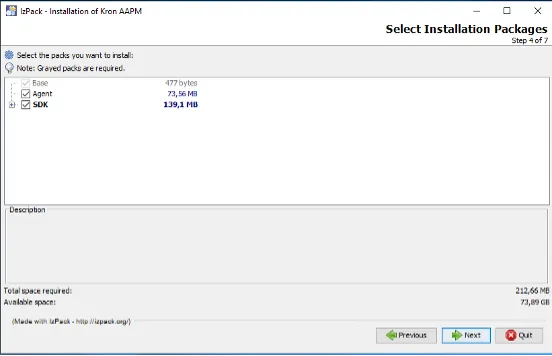
When running the executable installation file, a package installation popup appears. In the popup, the Agent, SDK, and Tool packages are selected, and then the Kron PAM IP Address, Registration Key, and gRPC port are configured to complete the installation.
After installation, the status of the agent service can be checked by running services.msc in the search field to verify the Kron AAPM Agent service is running.
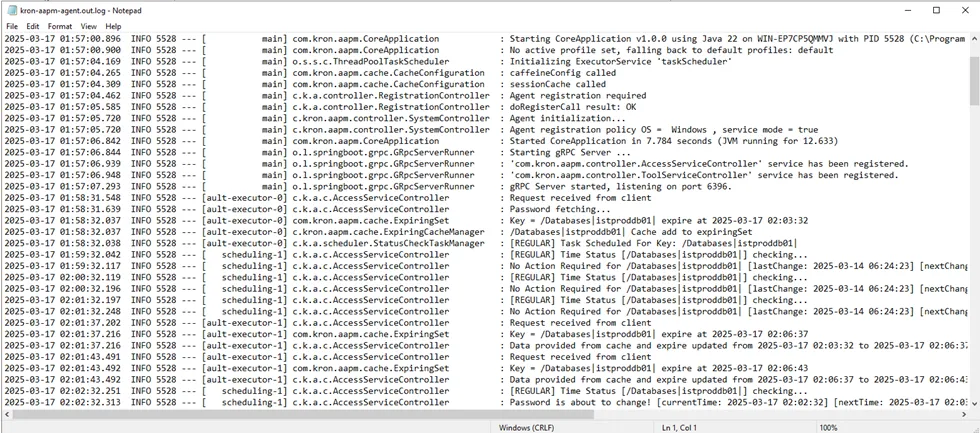
Logs related to the agent can be checked under the kron-aapm-agent.out.log file in the directory where the agent is installed. In case of a service restart or agent cache status changes, logs are recorded with a timestamp.
Silent Installation Overview
The silent installation process is automated through a setup script that manages all necessary steps. This script includes:
- install.jar – The main installation package that performs the deployment.
- silent-install.properties – A configuration file that defines the installation parameters.
Silent Installation Properties File
The silent-install.properties file contains key configuration parameters that must be customized before running the installation script. The parameters and description information in the configuration file are provided in the table below.
Parameter | Description |
|---|---|
INSTALL_PATH | Target directory where the agent will be installed (default installation path is "/opt/KronPAM/") |
sc.primaryIp | IP Address of Kron PAM's Primary Node |
sc.secondaryIp | IP Address of Kron PAM's Secondary Node |
sc.initialToken | Registration token required during the initial installation. |
sc.agentName | Name assigned to the AAPM Agent instance. |
sc.ssl.ignored | Ignores Kron PAM SSL certificate errors (true/false) |
sc.hostname.ignored | Ignores hostname verification of the Kron PAM environment |
sc.verified.hostname | Enforces hostname verification of the Kron PAM |
security.enabled | Enables AAPM Agent certificate validation |
security.cert | CA-signed or Self-Signed certificate's path (.jks) ("kron-agent" user must have access to the file and must have read permission) |
security.password | CA-signed or Self-Signed certificate's keystore password |
grpc.port.loc | gRPC port number to be used for communication between the agent and SDKs. |
Agent | Includes AAPM Agent installation (default value=1) |
SDK | Includes Kron PAM AAPM SDKs to installation |
Silent Install
To perform a silent installation, place both the install.jar file and the silent-install.properties file in the same directory. Before proceeding, verify that all required installation parameters are correctly specified within the silent-install.properties file. Once configured, execute the install.jar file to initiate the installation process.
java -jar install.jar -console -defaults-file silent-install.properties -autoThe install_aapm_agent.sh script automatically:
- Creates the necessary service definitions.
- Configures agent user and permissions.
- Starts the AAPM Agent service upon successful installation.
AAPM Agent Application Properties
The parameters in the application.properties file located in the AAPM Agent installation folder can be changed after installation if needed. Changing these parameters requires a restart.
Parameter Name | Description |
|---|---|
grpc.port | gRPC port number to be used for communication between the agent and SDKs. |
singleconnect.address | IP Address/Hostname of Kron PAM's Primary Node |
singleconnect.failoverAddress | IP Address/Hostname of Kron PAM's Secondary Node |
singleconnect.agentName | Name assigned to the AAPM Agent instance |
singleconnect.ssl-ignored | Parameter to be used to ignore certificate validation errors |
singleconnect.hostname-ignored | Parameter to be used to ignore certificate hostname validation errors |
singleconnect.installToken | Registration token required during the re-registration |
app.grpc.security.protocols | SSL version to be used (comma seperated. E.g. TLSv1.2,TLSv1.3) |
app.grpc.security.ciphers | SSL ciphers to be used (comma seperated. E.g. TLS_ECDHE_RSA_WITH_AES_256_GCM_SHA384,TLS_ECDHE_RSA_WITH_AES_128_GCM_SHA256) |
app.grpc.security.enabled | Enables gRPC over SSL |
app.grpc.security.dist.cert-chain | CA-signed or Self-Signed certificate's path (.jks) ("kron-agent" user must have access to the file and must have read permission) |
app.grpc.security.keystore-password | CA-signed or Self-Signed certificate's keystore password |
AAPM Agent Cache Parameters
The parameters related to the AAPM Agent cache can be configured in the application.properties file after installation.
password.statusCheck.period.regular | Defines how frequently the AAPM Agent verifies the password statuses of cached accounts by querying Kron PAM |
|---|---|
password.statusCheck.period.intensive | Specifies an accelerated polling interval used to verify the password status of cached accounts against Kron PAM. As the password nears its expiration date, the system increases the frequency of status checks to ensure timely detection and synchronization. |
password.statusCheck.period.bufferInSeconds | Defines an additional buffer interval applied during password rotation for cached accounts. The buffer duration is determined by the execution status of the password change job in Kron PAM, ensuring sufficient time for successful completion and synchronization before subsequent actions are triggered. |
password.statusCheck.period.graceInMinutes | This parameter refers to the extended cache time that takes effect when the AAPM Agent cannot reach either of the redundant Kron PAM addresses. When the Kron PAM servers cannot be reached, the password is stored in the AAPM Agent's cache for this extended cache time. If the password request time exceeds this period, this parameter is discarded for that password. |